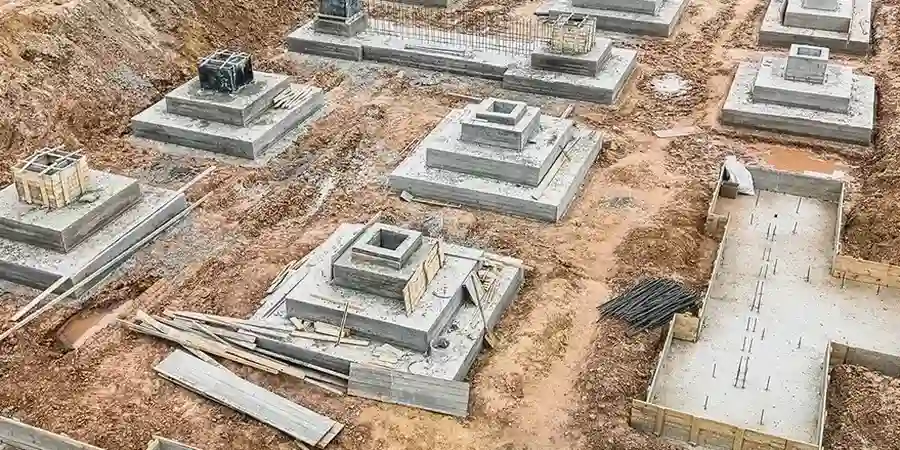
Foundations are the critical interface between any structure and the ground beneath it, and in Calgary, their design and performance are shaped by a unique and often challenging geological setting. This category encompasses the full spectrum of geotechnical services required to ensure that buildings, bridges, and industrial facilities are supported safely and durably. From evaluating native soils and bedrock to designing deep and shallow foundation systems, our work directly addresses the risks posed by variable ground conditions. For property owners and developers, a comprehensive foundation strategy is not merely a code requirement—it is an investment in the long-term integrity and value of the asset.
Calgary's subsurface conditions are dominated by glacial deposits overlying Cretaceous bedrock, creating a landscape where soil types can change dramatically over short distances. The region features extensive layers of glacial till, lacustrine clays, and alluvial sands and gravels, particularly along the Bow and Elbow River valleys. These deposits often include compressible silts and clays, which are prone to long-term consolidation settlement. More critically, the dry climate and silty soils in parts of the city have led to the formation of collapsible soils, which can undergo sudden volume reduction when wetted. A thorough collapsible soil evaluation is therefore a prudent first step on many sites to prevent future structural distress.
Geotechnical practice in Calgary is governed primarily by the Alberta Building Code (ABC), which adopts the National Building Code of Canada (NBC) with provincial amendments. The ABC references the Canadian Foundation Engineering Manual (CFEM) as the standard of practice for geotechnical investigations and foundation design. These documents mandate minimum investigation depths, factor of safety requirements for bearing capacity, and settlement performance criteria based on structure type. For deep foundations, CSA S6 (the Canadian Highway Bridge Design Code) often applies to transportation structures, while CSA A23.3 provides guidance on the structural design of concrete piles. Compliance with these standards ensures that designs meet both ultimate limit states (strength) and serviceability limit states (deflection and vibration).
The types of projects that demand rigorous foundation engineering in Calgary range from single-family homes on sloping lots to high-rise towers in the downtown core and infrastructure like the Green Line LRT. Light industrial buildings in areas like Foothills Industrial often require foundations on fill analysis due to pre-existing, poorly compacted backfill. Residential developments on the city's expanding outskirts frequently encounter soft clays, necessitating a detailed settlement analysis to prevent cracked drywall and sticking doors. For mid-rise condominiums where column loads are high but subsurface access is limited, a raft/mat foundation design can distribute loads efficiently and mitigate differential movement. Meanwhile, major infrastructure and bridge projects routinely rely on a pile foundation design to transfer loads to competent bedrock.
The most frequent issues stem from Calgary's variable glacial soils and dry climate. Differential settlement of structures founded on compressible clay or improperly compacted fill is widespread, leading to cracking. Collapsible silty soils, which consolidate rapidly when wetted by irrigation or leaking utilities, are another major cause of distress. Additionally, heaving of shallow foundations due to frost penetration in winter must be addressed through proper depth of burial.
The Alberta Building Code prescribes a minimum footing depth of 1.2 meters (4 feet) below finished grade for most structures to protect against frost penetration. However, this depth can be greater for unheated buildings or sites with high groundwater. A site-specific geotechnical investigation may recommend deeper embedment if frost-susceptible silts are present, as these soils can generate significant heave pressures even at the standard depth.
Shallow foundations, like strip footings and raft/mat slabs, transfer loads to the ground near the surface and are economical where competent soil exists within a few meters. They are common for houses and low-rise buildings. Deep foundations, such as driven piles or drilled shafts, bypass weak or compressible upper strata to bear on dense till or bedrock. They are specified when surface soils are inadequate, for heavy structures, or where differential settlement must be strictly controlled.
Yes, the Alberta Building Code requires a geotechnical investigation for all buildings, with the scope scaled to the project's size and risk. The investigation must be conducted by a professional engineer and typically involves drilling boreholes, sampling soils, and testing to determine bearing capacity and settlement characteristics. Building permits will not be issued without a stamped geotechnical report that provides foundation recommendations in compliance with local regulations.